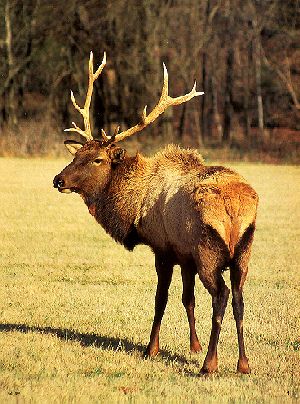
Elk once numbered in the millions and
occupied habitats spanning most of North America. Unfortunately, shrinking habitat and
overhunting reduced populations to a few persistent herds in the mountainous West. Had the
elk not been remarkably adaptable, it might now be extinct.
The eastern elk (Cerrus elaphus canadensis) lived in eastern boreal and hardwood forests.
This was the subspecies native to Arkansas, though historical records indicate it
persisted no later than the 1840s. It is now extinct.
The U.S. Forest Service introduced Rocky Mountain
elk (Cersus elaphus nelsoni) in Franklin County's Black Mountain Refuge in 1933. Three
bulls and eight cows from Wichita National Wildlife Refuge in Oklahoma were released. The
population grew to 125 by 1948, but by then, wildlife biologists were concerned about the
herd's future. The herd increased to an estimated 200 by the mid 1950s and then vanished.
No one knows for sure what caused these elk to disappear. Some speculate that illegal
hunting, natural mortality and shrinkage of suitable range through natural ecological
succession eventually resulted in their extermination.
In 1981, the Game & Fish Commission, in cooperation
with private citizens and the National Park Service, initiated another elk restoration
project in the Ozark Mountains of northwest Arkansas. Between 1981 and 1985, 112 elk from
Colorado and Nebraska were released at five sites near Pruitt in Newton County. All
release sites were on or adjacent Buffalo National River lands. Some elk were ear-tagged
and tested for diseases such as brucellosis and leptospirosis prior to release.
The Game & Fish Commission and Park Service monitor elk using field observations,
helicopter counts and, in recent years, thermal infrared sensing equipment. Elk have been
reported in Washington, Carroll, Boone, Marion, Newton, Searcy, Stone, Conway, Pope, Van
Buren, and Faulkner counties, but most of the approximately 350 elk in the Arkansas herd
occur along 67 miles of the upper and middle Buffalo National River corridor in Newton and
Searcy counties, primarily on National Park Service land.
Arkansas elk range covers approximately 225,000 acres.
Gene Rush/Buffalo River Wildlife Management Area, which borders Park Service property
along the river, is included in this area, and elk are also found seasonally on
surrounding private lands. A small breeding population is thought to be established on
private land in southwest Boone and southeast Carroll counties.
Use by elk of national forest lands along the Richland Creek drainage in Searcy County
appears to be seasonal. The few elk seen elsewhere in the state are considered transients.
Each year since 1991, biologists in helicopters have counted elk along the Buffalo River
corridor and in some private land areas. Seventy-six elk were counted in 1991, 144 in
1992, 142 in 1993 and 140 in 1994. Calf/cow ratios have ranged from 40 to 49 calves per
100 cows, which suggests adequate reproduction. Bull/cow ratios have ranged from 39 to 54
antlered bulls per 100 cows, which compares favorably with data on established elk herds
in some western states.
A thermal infrared sensing project initiated in 1994 provides more precise information on
elk numbers and distribution. In February and March 1994, 312 elk were found on national
park land, AG&FC land and adjacent private lands along the Buffalo River corridor
between Boxley and the Highway 65 bridge at Silver Hill. The survey area included all
areas normally surveyed by helicopter and additional private and national forest lands
where elk were reported in recent years.
Fifty-five elk deaths were documented between 1981 and 1993. Poaching (32 percent) and
disease (31 percent) are primary factors in these losses.
Without suitable habitat, elk would soon disappear from Arkansas. Realizing this, state,
federal and private interests have worked together to expand and improve elk habitat along
the Buffalo River.
Since 1992, the Game & Fish Commission, cooperating with the Rocky Mountain Elk
Foundation, has done extensive habitat improvement work on 17,652-acre Gene Rush/Buffalo
River WMA. As a result, elk use of the WMA has increased recently, and more habitat work
is planned for the future.
The National Park Service also wants to ensure the future of the elk herd. Their efforts
to create and maintain beneficial elk habitat along the Buffalo have included conducting
prescribed burns, maintaining hay fields and establishing native grass openings.
Based on available habitat along the middle and lower Buffalo, it seems likely elk will
expand their current range toward the mouth of the river. Suitable range also exists on
private lands in the region, but private landowners may not tolerate extensive elk use. A
few are already complaining.
Interest in Arkansas elk increases each year. More and more Arkansans visit the Buffalo
River area to see and photograph these magnificent animals, especially in late September
and early October when elk are breeding. The herd will never be large compared to herds in
western states, but these elk provide unique wildlife watching opportunities, and those
who come to see them provide additional tourist revenue for state and local economies.
An elk program team composed of Game & Fish and National Park Service staff recently
drafted an elk management plan. Their recommendations include developing and funding
future habitat improvement and research projects, formulating plans for a limited elk
hunting program in the future, developing a statewide nuisance elk policy, developing
public elk viewing sites and assessing sites for herd expansion onto public lands.
This article courtesy Arkansas Wildlife Magazine |