Use
Permissions & Copyright Notices
DigiMarc Tracking
Any person is welcome to print out anything
on the 2Cooleys Sylamore Area Recreation web site as long as such print-outs are used only
for enjoying the tours without commercial intent. Please DO NOT add any of the photos,
maps, or text to your own web site. This is because the content changes on a regular basis
as roads, trails, and other features are closed, altered, or otherwise changed in a
significant manner. Further, any unauthorized use of any part of this web site violates
Federal copyright laws. To ensure accuracy for all, and to avoid copyright violations for
you, please just link to our maps, photos, or pages you wish to share.
For use fees and use permission please contact 2Cooleys directly.
Copyright Notice - Except for
print-outs made by private parties for non-commercial personal use on the tours depicted
in this web site, no part of this 2Cooleys web site may be reproduced, in any media for
any reason, by any party, without first obtaining written permission from Ozark Mountains
Website, Inc., DBA 2Cooleys.Com. This includes photographs, parts of photographs, maps, or
parts of maps, and all text, in whole or in part, as covered under Federal Copyright laws.
The act of using any part of this Web site
in any media for any reason other than actual personal non-commercial use on the tours
depicted in this web site, by any party who has not first received specific written use
permission from Ozark Mountains Website, Inc., shall be construed to be that party's
automatic agreement to pay upon demand to Ozark Mountains Website, Inc. or it's legal
assigns, a use fee of $1,000 per each unauthorized use occurrence in any media.
For use fees and use permission please contact 2Cooleys directly.
The Digital Millenium Copyright Act of 1998
& DMCA Actions
When we discover unauthorized use of our maps, photos, or text, or any part of the former
as derivative works, we contact the offending party once by phone and request that the
infringement be removed. Many times it is an innocent mistake. IN cases where people do
not willingly cooperate we contact their web site hosting company and inform that hosting
company of the copyright infringement. Upon this notice from us, under Federal Law that
came into effect in 1998, the hosting company is required to remove the files from their
servers once we prove we are the copyright owners. That is very easy to do, and we have
done this many times. Stolen images simply disappear from the offender's web site. This
act is called a "DMCA Complaint". This is Federal law that all hosting companies
strictly enforce. They do not waste time trying to explain copyright law to people who
violate copyright law, they just remove it.
How DigiMarc Photograph
& Image Tracking Works
The Copyright notice on each photograph is
not the digital watermark.
How Computers "See" Images &
Photographs
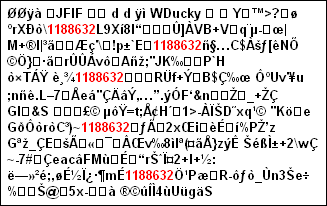
In this image you see computer code which does not appear to make sense. However, to a
computer, it makes perfectly good sense. This strange-looking code contains the
instructions telling a computer how to render a picture on a monitor. To computers this is
how all photographs and images "look". It is technically very easy to add
tracking numbers to this code.
Invisible Digital Tracking Number
Notice that the numbers in red are not like the rest of the code around them. This is the
special DigiMarc digital watermark which can be found by the DigiMarc search engine. The
watermark is actually an ID number that is unique for each photograph.
Visit the DigiMarc Corporation
Website
Locating Stolen Images
To locate where a photograph or other image is being used without permission we simply
enter photo ID numbers in the DigiMarc search engine. This special search engine
automatically searches the entire World Wide Web continuously looking for these ID
numbers. When it finds our ID numbers it sends us an email indicating where the image was
found.
It Stands Up In Court
The DigicMarc technology has been around for well over ten years. Since many people do
steal images from web sites, many have been sued for copyright infringement. In several
well-known copyright infringement law suits, DigiMarc technology has been upheld as valid
proof of theft and other copyright infringements. Under Federal Law, the minimum fine for
copyright infringements is $20,000.
DigicMarc Can't Be Removed
Some people think they are being clever when stealing images because they crop or
otherwise alter the image. That does not remove the digital watermark. Cropping,
re-sizing, re-naming the file, or any other "trick" does not remove the
watermark. This is because the digital watermark is embedded in the image or photograph
many times, not just once or twice. This is so that derivative works can also be traced to
illegal use.
Derivative Works Illegal Too
Some people think using only half of an image is legal because it is not the entire image
or photograph. This is not true. Under Federal Law using any part of an image or
photograph is called a "derivative work" because the new image or photograph was
created from the original, that is, the new image or photograph was derived from the
original.
Why?
Some ask why we are so "nasty" about not letting others use our photographs and
maps. Quite simply the answer is because we worked our asses off to make all those photos
and maps, and because we sell these photographs, and they are a big part of our annual
income. The fact that someone wants to use one of our photographs does not give them the
automatic right to use them.
Yes They ARE Copyrighted!
We do file for Copyright protection with the United States Patent and Trademark Office.
Since commercial photography has been around since before 1860, the United States Supreme
Court has set precedent many times on what is, and what is not, copyright protection. For
over 100 years the highest court in America has ruled that as soon as the photographer
takes the photograph a copyright for that photograph has been established. The process of
filing for the copyright is needed only helps to prove ownership of the photograph. A
photograph which has not been filed with the USPTO by the photographer is still protected
under copyright law.
|

